Why outside
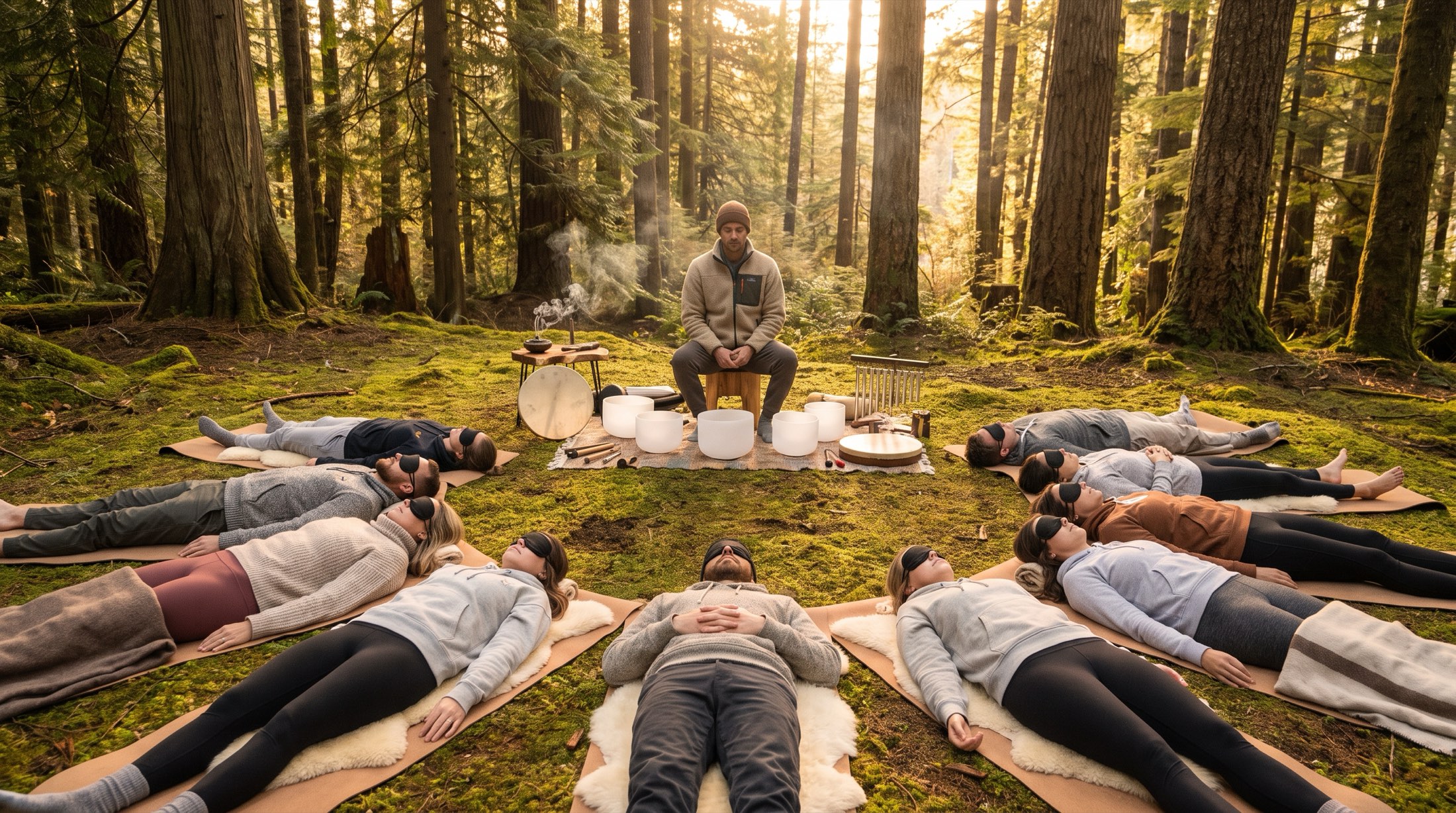
Breathwork works indoors. A quiet room, drawn curtains and a good speaker will take you a long way, and when the weather turns that is exactly where we go. But something happens in a forest clearing that a room cannot reproduce, and it is worth being specific about what.
The first thing is scale. Lying on your back with two hundred feet of Douglas fir above you, the body reads its surroundings as both safe and very large. People describe the difference as having more room to put things down.
The second is sound. A room is silent or it has music in it. A forest has a floor of sound underneath the music: wind working through cedar, ravens arguing, a creek, the sea if we are close to it. During the quiet stretch after the breathing, that floor is what you come back to.
The third is air. Active breathing moves a lot of it, and cool air on the face while you work is a different sensation from the warm, still air of a studio. Most people find it easier to keep the rhythm going outside.
The fourth is light, which matters more than you would expect given that everyone is wearing an eye mask. Sessions are timed for sunset, so the light is falling the whole time. You take the mask off into a different hour than the one you lay down in.
Where we meet
Forest locations in and around Victoria, within roughly a thirty minute drive of downtown. The terrain around this city is unusually good for it: the Highlands and the Sooke Hills to the west, the ridges above Langford and Colwood, and the quieter pockets of the Saanich Peninsula to the north.
We look for clearings that are flat, sheltered from wind, far enough off a main trail that twenty people lying down are not in anyone's way, and close enough to parking that you can carry a mat and a blanket in without it becoming an expedition. Expect a walk in of five to fifteen minutes on a trail.
The location for each session is confirmed by email a few days ahead, once the forecast is readable enough to commit to. That is also when you will get parking directions and a meeting point.
Sunset timing
Sessions are built around sunset rather than a fixed weekly slot, which means the start time moves through the year. In late June that puts us starting a little after nine in the evening. In December it is closer to half past four in the afternoon.
The shape is the same either way. You arrive and settle while there is still light. The active breathing runs through the last of it. The sound and the closing circle happen as the clearing goes properly dark.
Bring a headlamp for the walk out. Holding a phone light in your teeth while carrying a mat, a blanket and a water bottle is a worse plan than it sounds.
An island year
Rain is less of an obstacle than people assume. A light drizzle under a canopy is genuinely pleasant to breathe in, and we will run through it. The things that actually move a session indoors are different.
Wind is the main one, because it makes a guiding voice hard to hear and makes a clearing cold fast. Sustained rain is the second, mostly because the ground stops being somewhere you want to lie for ninety minutes. Cold is the third. You generate real heat during the active breathing, but the twenty minutes afterwards are still and that is when the ground pulls it back out of you.
In practice, late spring through early autumn is the outdoor season here, and it is a long one. Through the wet months most sessions are indoors, with outdoor dates added whenever a clear, still evening appears in the forecast. Everyone on the list hears either way, so you always know which one you are coming to before you leave the house.
What to bring outdoors
- A yoga mat, or a closed cell foam pad if you have one. Foam insulates better than rubber.
- Two blankets. One to lie on, one to go over you for the quiet part.
- A headlamp, for the walk out in the dark.
- Layers, including more than you think you need for after.
- Warm socks and a toque. Heat leaves through the feet and the head while you are lying still.
- Water.
- A notebook, for anything that comes up.
Eye masks are provided. We carry spare mats, blankets and sheepskins, so if you turn up with none of this you will still be warm and off the ground.
Questions people ask
Is outdoor breathwork cold?
During the active breathing, no. The work itself generates a surprising amount of heat and most people end up shedding a layer partway through.
The part to prepare for is afterwards, when you are lying still for twenty minutes or so. That is what the second blanket, the warm socks and the toque are for. Insulation underneath you matters more than what you put on top.
What happens if it rains?
Light rain under a canopy is fine and we will usually run through it. Sustained rain, strong wind, or cold that makes lying still unpleasant moves the session indoors instead.
Either way you will know which it is a few days ahead. The location email goes out once the forecast is settled enough to commit to.
How far is the walk in from parking?
Five to fifteen minutes on a trail. You will be carrying your own mat and blankets, so pack accordingly, and a backpack beats a tote bag.
If a walk of that length is not workable for you, say so when you join the waitlist. Some locations are much closer to the road than others and we can point you at those dates.
Do I need experience to do breathwork outdoors?
No. Every session is guided from start to finish, outdoors or in, and most people at any given session are on their first or second. You lie down, you follow the cues, and the practice does the work.
Breathwork does involve strong, active breathing. If you are pregnant, or have a history of cardiovascular problems, seizures or a serious psychiatric condition, talk with your doctor first and let us know so we can support you.