Why breathing reaches anxiety at all
Anxiety is partly a story and partly a body state, and the body state is the part you cannot argue with. Reasoning rarely talks a racing heart down. What makes breathing unusual is that it sits on both sides of the line: it runs automatically, like heart rate and digestion, but unlike them it accepts voluntary input at any moment. It is the one control surface on the autonomic nervous system you can always reach.
The mechanism that matters most is the link between the exhale and the heart. Your heart rate rises a little on each inhale and falls on each exhale, an effect called respiratory sinus arrhythmia. The falling part is the vagus nerve applying a brake. Breathe out for longer than you breathe in and you lean on that brake more often and for longer, and heart rate, blood pressure and the sense of urgency follow it down.
This is why almost every calming breath practice ever invented, across very different traditions, ends up emphasising a long exhale. They are all pulling the same lever.
Two different things get called breathwork
Search for breathwork and anxiety and you will be shown two practices that share one name and do close to opposite things. Understanding which is which is the most useful thing on this page.
Down-regulating breathing
Slow, usually nasal, weighted toward the exhale. Fewer breaths per minute than you would take on your own. It is quiet, it is undramatic, and it is what you want when you are anxious right now. Everything in the next section is this kind.
Activating breathwork
Faster and deeper than the body needs, often through the mouth, sustained for twenty to forty minutes. Breathing that hard for that long lowers carbon dioxide in the blood, and that produces tingling in the hands and face, lightheadedness, sometimes cramping in the hands, and frequently strong emotion. It is the kind of breathwork we facilitate at our sessions.
It is not a calming technique. It is closer to the emotional equivalent of hard exercise, and like hard exercise the settled feeling arrives afterwards rather than during.
So: if you are in an anxious spiral on a Tuesday night, you want the first kind. If you are after something that opens things up over a longer arc, and you have the ninety minutes and the support to do it properly, the second. Reaching for the second when you needed the first is how people end up more wound up than they started.
Four things you can try tonight
None of these need an app, a mat or a teacher. They are all the down-regulating kind.
The physiological sigh
Two inhales through the nose, the second a short sip stacked on top of the first, then a long slow exhale through the mouth until you are empty. Repeat for one to five minutes. This is the fastest of the four, and the one with the best recent evidence behind it. It is also what your body already does spontaneously when you sob or when you are relieved.
Extended exhale
In through the nose for a count of four, out through the nose or mouth for a count of eight. The ratio matters more than the numbers, so if four and eight feels like a stretch use three and six. Five minutes.
Resonance breathing
In for five, out for five, nasal, no pauses. That is six breaths a minute, roughly the rate at which the oscillation between breath and heart rate lines up most strongly. Less immediately dramatic than a sigh but good as a daily ten minutes.
Box breathing
In for four, hold four, out for four, hold four. The holds give a busy mind something structural to do, which is why it suits people who find slow breathing boring enough to abandon. Skip the holds if they make you feel short of air.
If any of these makes you feel worse, dizzy or panicky, stop and breathe normally. Breath holds and forceful breathing are the two things most likely to do that, so drop those first.
What the evidence actually shows
Worth being straight about, because this field is not short of overclaiming.
Slow, structured breathing has reasonable support. The most cited recent trial is Balban and colleagues in Cell Reports Medicine in 2023, a randomised controlled trial of five minutes a day for a month. Cyclic sighing, the physiological sigh above, produced greater improvement in mood and greater reduction in self-reported anxiety than an equal daily dose of mindfulness meditation, along with a lower respiratory rate.
The same trial found no significant change in heart rate variability or resting heart rate in any group. That is a useful corrective: the benefit showed up in how people felt and reported, not in a measurable permanent retuning of the autonomic nervous system. Anyone selling you breathwork on the strength of HRV numbers is ahead of the data.
That trial also tested cyclic hyperventilation with retention, which is much closer to what happens at a session like ours. It too beat mindfulness on positive affect, but cyclic sighing was the stronger effect of the two.
Across the wider literature, slow-breathing interventions tend to show small to moderate reductions in anxiety symptoms. The trials are usually small, short, nearly impossible to blind, and often compared against weak controls, all of which should temper confidence. Evidence for intensive activating breathwork as a treatment for anything is thinner and more preliminary still.
What that adds up to, honestly: breathing practices are a real and useful tool with modest effects, available for free, with very little downside for most people. They are not a treatment for an anxiety disorder and nobody should present them as one.
Where a guided session fits
A ninety minute group session is not a technique you deploy during a difficult afternoon. It is a longer, deeper, more emotional thing, and it is useful for different reasons.
What people tend to get from it is access rather than relief: tension that has been sitting somewhere for years finally moving, grief that never had a container, a stretch of quiet deeper than they can usually reach on their own. Some people cry. Some people laugh. Some people lie there peacefully and nothing dramatic happens at all, and that is a perfectly good session.
It pairs well with the daily five minutes rather than replacing it. The short practices are what you use to manage a nervous system week to week. The sessions are where you occasionally put something down.
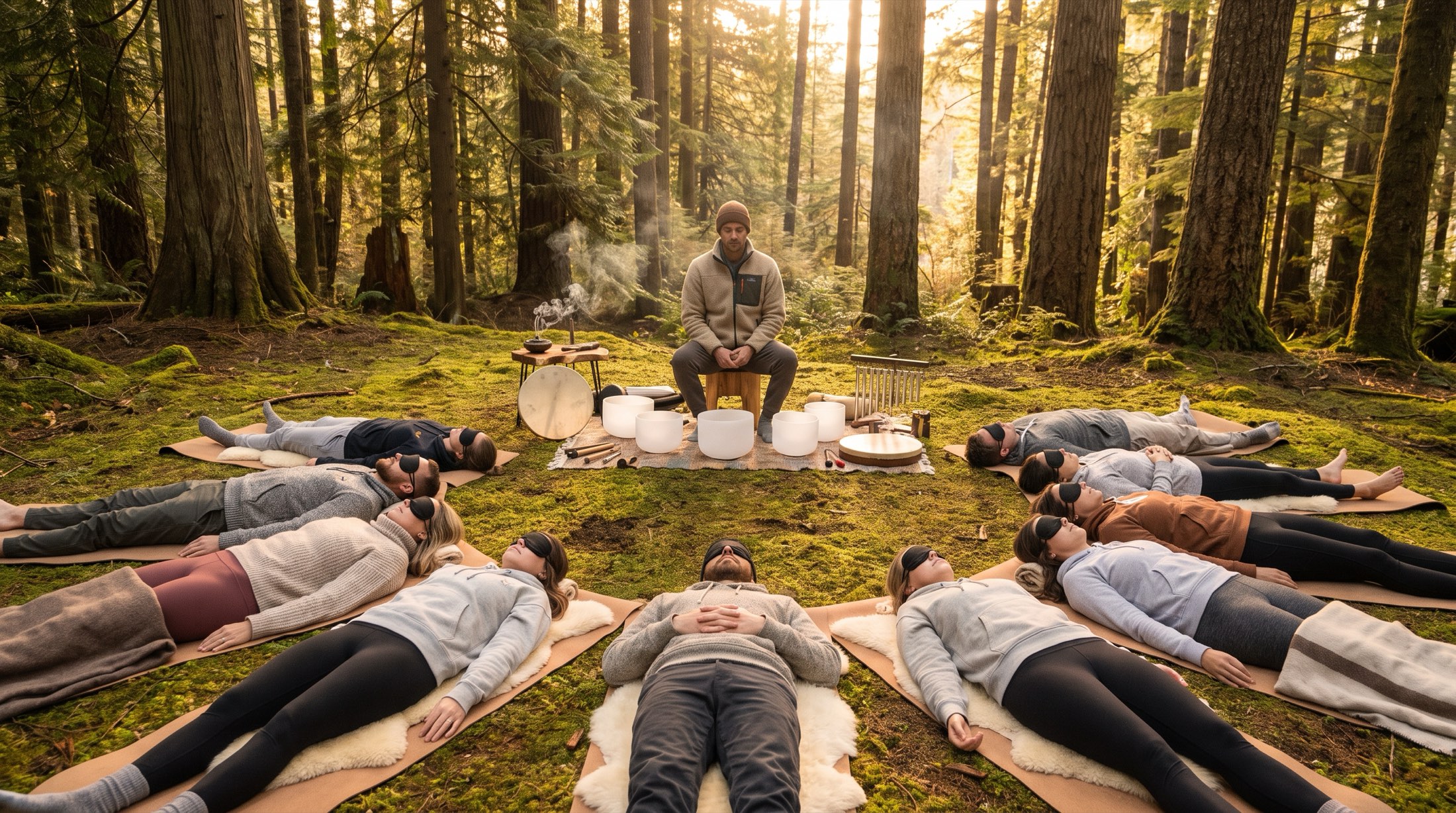
Ours run outdoors at forest locations near Victoria when the weather allows, and indoors when it does not. The full picture of what a session involves, and why we do it outside.
When to be careful
The slow practices above are safe for nearly everyone. Activating breathwork, the kind done in sessions, is a stronger intervention and deserves more caution.
Talk to a doctor before doing intensive breathwork if you are pregnant, or if you have a history of cardiovascular problems, high blood pressure, seizures or epilepsy, aneurysm, recent surgery, glaucoma or retinal detachment, or a serious psychiatric condition including psychosis or bipolar disorder. Strong, sustained breathing changes blood chemistry and pressure, and those are the conditions where that matters.
Separately, and this gets less attention than it should: activating breathwork can bring up difficult material quickly. That is often the point, but it means doing it somewhere with a facilitator present and some support afterwards, rather than alone from a video. If you are in active crisis, or working through recent trauma, a group session is probably not the right first step, and a therapist is.
None of this is medical advice. It is a description of a practice, written by the people who run it, and it is not a substitute for assessment by a clinician who knows your history. If you are struggling, talk to your doctor. In British Columbia you can also reach the provincial crisis line at 1-800-784-2433, or 988 for suicide crisis support.
Questions people ask
Does breathwork actually help with anxiety?
Slow, exhale-weighted breathing has reasonable evidence behind it for reducing anxiety symptoms and improving mood, with small to moderate effects. A 2023 randomised trial in Cell Reports Medicine found five minutes a day of cyclic sighing outperformed an equal dose of mindfulness meditation on both mood and anxiety.
It is a genuinely useful tool, not a cure, and not a treatment for an anxiety disorder. The evidence for intensive activating breathwork is considerably thinner than for the slow practices.
What breathing should I do during a panic attack?
Something slow and exhale-weighted. The physiological sigh works well: two inhales through the nose, then a long slow exhale through the mouth, repeated.
Avoid breath holds and avoid fast or forceful breathing, both of which can make the sensations of panic worse. If you are hyperventilating, the goal is fewer and slower breaths, not deeper ones.
Can breathwork make anxiety worse?
Yes, and it is worth knowing in advance. Fast, deep, sustained breathing lowers carbon dioxide and produces tingling, lightheadedness and a racing heart, sensations that closely resemble panic and can trigger it in people prone to panic attacks.
Activating breathwork can also surface difficult emotional material faster than someone is ready for. That is why it belongs in a facilitated setting rather than done alone, and why we ask people to tell us about any relevant history.
Is breathwork a replacement for therapy or medication?
No. Nobody running an honest breathwork practice will tell you otherwise. If you are on medication, do not change it on the strength of a breathing practice without talking to the prescriber.
Breathwork sits alongside those things reasonably well. Plenty of people use it as one part of a wider approach that also includes therapy, exercise, sleep and treatment.
How long before breathing practices make a difference?
A single physiological sigh sequence can take the edge off within a minute or two. That effect is immediate and small.
For a shift you notice in general baseline anxiety, the trial evidence points at about five minutes a day for several weeks. It is a daily-habit intervention more than a one-off one.