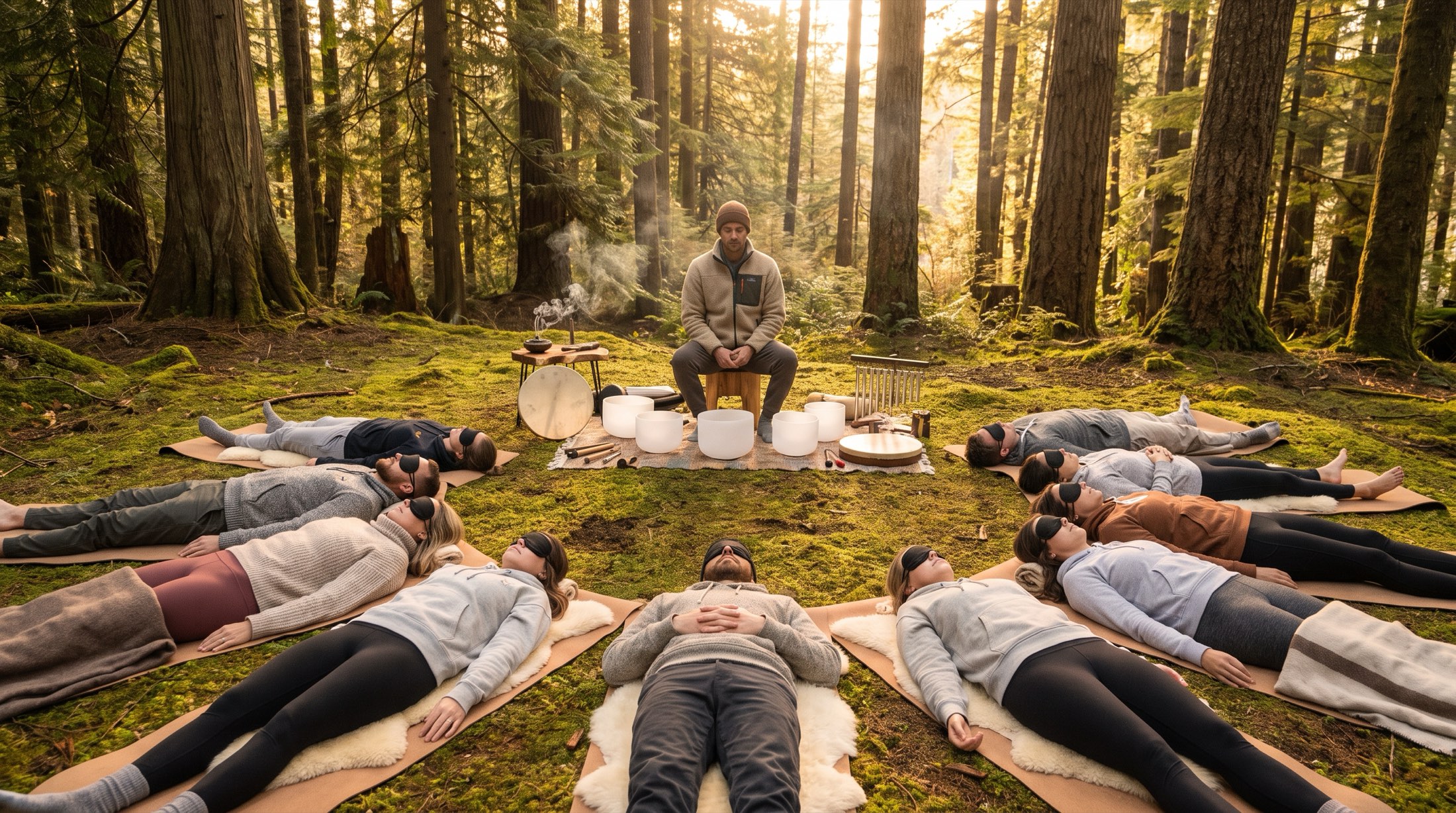
What a sound bath is
A sound bath is a session where you lie down, do nothing, and let sustained tones wash over you for somewhere between thirty and ninety minutes. There is no technique to learn and nothing to get right. Singing bowls, gongs, chimes and voice are the usual instruments. The word bath is doing real work in the name: the point is immersion rather than performance, and the sound is meant to arrive from all around you rather than from a stage.
It is not a concert and it is not quite meditation either. Most people drift somewhere between waking and sleeping, and a fair number genuinely fall asleep, which nobody minds.
How sound works in our sessions
Breathwork Victoria is a breathwork practice that uses sound, rather than a sound bath practice that happens to include breathing. The distinction matters for what you should expect.
A session runs about ninety minutes and the shape is roughly this. You arrive and settle onto a mat with an eye mask. The facilitator guides an active, connected breathing rhythm for thirty to forty minutes, carried by music. Then the breathing instruction stops.
That is where the sound comes in, and it comes in for a reason. After thirty or forty minutes of hard, deliberate breathing, the body is wide open and the thinking mind is unusually quiet. Handed silence at that moment, most minds reach for something to do and start narrating. Handed sustained tone instead, they stay where the breathing put them. The sound is less a treatment than a way of holding the door open for another twenty minutes.
After that there is a short optional circle for anyone who wants to say what came up, and then everybody packs up their blankets and walks out.
The instruments
Singing bowls
Struck and then played around the rim so the tone sustains. What makes bowls useful at this point in a session is how long a single note lasts and how little it demands: there is no melody to follow, no rhythm to track, nothing resolving. Attention rests on it without working.
A drum
Played slowly and steadily rather than rhythmically, more heartbeat than groove. Low frequencies are felt through the ground as much as heard, which is more pronounced outdoors on earth than it is on a studio floor.
Chimes
Used sparingly and mostly near the end, as punctuation. Clear high tones are what bring people back up without jolting them, which is why the session closes with them rather than with a voice.
How this differs from a sound bath on its own
If you have been to a sound bath and are wondering whether this is the same evening with extra steps, it is not, and the difference is mostly about effort and intensity.
A sound bath is passive from start to finish. You arrive, you lie down, you receive. It is restorative, it is gentle, and you can do one on a weeknight and go to work the next morning without a thought.
A breathwork session asks for forty minutes of real physical effort first, and that changes what the sound lands on. Active breathing at that intensity lowers carbon dioxide in the blood, which produces tingling, lightheadedness and often strong emotion. People cry in breathwork sessions far more often than they cry in sound baths. By the time the bowls start you are in a different state than you would be lying down cold, and the sound goes correspondingly deeper.
Neither is better. They are different doses. If you want to be soothed, a sound bath. If you want something moved, breathwork with sound at the end.
Victoria has people doing excellent standalone sound work, and if that is what you are actually after, go to one of them rather than to us. We would rather you got the thing you wanted.
What it feels like
Hard to write about without sounding either mystical or clinical, so here is the plain version of what people report.
The commonest description is that the sound seems to be coming from inside rather than from a point in the room, which is partly the eye mask and partly what forty minutes of breathing does to your sense of where your edges are. Several people a session say they could not tell whether the bowls had stopped.
Physical sensation is normal: tingling in the hands and face, warmth, occasional involuntary movement or shaking as tension lets go, a heaviness that makes getting up feel like a decision. Emotion arrives without a subject attached often enough that it is worth saying in advance. Crying with no idea what you are crying about is a very common breathwork experience and not a sign anything has gone wrong.
And sometimes none of that happens and you simply lie in a forest clearing listening to a bowl in the dark, which is its own good evening.
On what sound does physiologically, we would rather undersell than overclaim. The research on sound healing is thin and the mechanisms often described for it run well ahead of the evidence. What sound reliably does is give attention somewhere undemanding to rest at the point in a session where that is most useful. That is enough to justify it, and we are not going to tell you the bowls are retuning your cells.
Questions people ask
Is this a sound bath or a breathwork session?
A breathwork session that closes with sound. The active breathing runs for thirty to forty minutes, and singing bowls, a drum and chimes carry the twenty minutes or so afterwards.
If you are looking for a purely passive sound bath with no active breathing, this is not that, and Victoria has practitioners who specialise in it.
Do I need to know anything about sound healing?
No, and there is nothing to do during that part of the session. You are lying down with an eye mask on. The sound is simply happening around you.
The only guided part of a session is the breathing, and that is cued from start to finish.
Where are sessions held in Victoria?
Outdoors at forest locations in and around Victoria, BC when the weather allows, and indoors when it does not. We stay within about a thirty minute drive of downtown.
The exact location is confirmed by email a few days ahead of each session.
How much is a session?
$40 CAD for a single session, or $160 for a five-session pack, which works out to $32 a session. That covers the full ninety minutes including the sound.
Nothing is charged while the waitlist is building. Sessions begin once a hundred people have joined.
Does the sound work differently outdoors?
Noticeably, yes. Outdoors there are no walls to reflect off, so tones carry and then simply stop rather than ringing around a room. Bowls sound drier and closer.
The drum changes most. Low frequencies travel through the ground, so lying on earth you feel it in a way a studio floor does not transmit.